Have you ever seen someone say, That food smells rank,” while another person talks about reaching a higher rank in a game?
If so, you may have wondered about the real rank meaning and why the word seems to have completely different interpretations.
The truth is that rank is one of those versatile words that changes meaning depending on the situation.
It can describe a person’s position in a military organization, a player’s level in a competitive game, a website’s placement in search results, or even something that smells terrible.
Understanding rank meaning is more important than ever because the word appears across social media, gaming communities, workplaces, schools, and everyday conversations.
Whether you’re a student, gamer, professional, or simply curious about internet language, knowing how rank is used can help you avoid misunderstandings.
This guide breaks down every major meaning of rank, where it came from, how people use it today, and plenty of real world examples.
Updated for 2026.
What Does “Rank” Mean?
Quick Answer
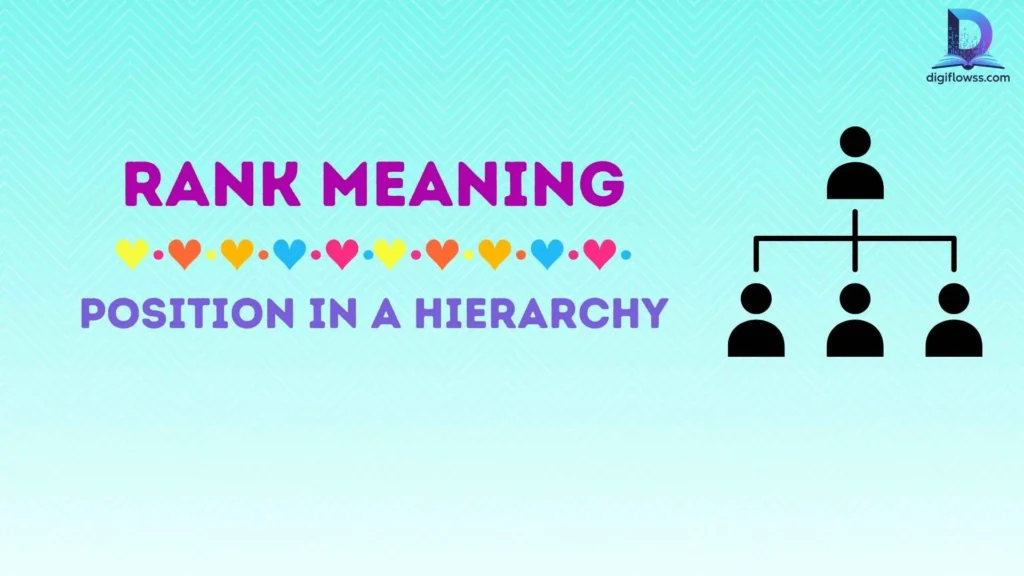
Rank means a position, level, status, or standing within a hierarchy, competition, organization, or system. In slang, especially British slang, rank can also mean disgusting, gross, or unpleasant.
The word “rank” comes from Old French and Germanic roots related to arranging things in rows or lines. Over time, it evolved to describe social positions, military levels, and ordered classifications.
Today, rank has several common meanings:
- Position in a hierarchy
- Competitive standing
- Military title
- Search engine placement
- Social status
- Slang for something disgusting
Pronunciation
Rank is pronounced:
/ræŋk/
It rhymes with:
- Bank
- Thank
- Frank
How the Meaning Has Evolved
Historically, rank referred primarily to social or military status. As technology evolved, the word expanded into:
- Gaming rankings
- Sports standings
- Academic rankings
- Search engine rankings
- Social media influence rankings
Meanwhile, British slang adopted rank as a way to describe something unpleasant or revolting.
How to Use “Rank” Correctly in Texts & Chat
The meaning depends entirely on context.
When Referring to Position or Status
Examples:
- “What’s your rank in Valorant?”
- “She earned a senior rank at work.”
- “Our website improved its Google rank.”
The tone is usually neutral and informational.
When Used as Slang
Examples:
- “That smell is rank.”
- “The leftovers are totally rank.”
Here, rank means gross, nasty, or unpleasant.
Platform-Specific Usage
SMS & WhatsApp
Most people use rank to discuss:
- Gaming levels
- School standings
- Work hierarchy
Example:
“Did your rank go up after the update?”
Rank appears in:
- Gaming content
- Fitness leaderboards
- Creator rankings
Example:
“Top rank achieved 🔥”
X (Twitter)
Users discuss:
- Sports rankings
- Trending rankings
- Search rankings
Discord
Gaming communities frequently use rank.
Examples:
- Bronze Rank
- Silver Rank
- Diamond Rank
Rank often appears in:
- Competitive gaming
- SEO discussions
- Sports conversations
When Not to Use Rank
Avoid using slang rank in formal settings.
Instead of:
“Your proposal is rank.”
Say:
“Your proposal needs improvement.”
Real Conversation Examples Using Rank
Between Friends
Alex: What rank are you now?
Sam: I finally reached Diamond yesterday.
Meaning: Refers to a competitive gaming level.
In a Group Chat
Friend 1: Did you smell the gym locker room?
Friend 2: Yeah, it was absolutely rank.
Meaning: Something smelled disgusting.
Dating Conversation
Taylor: How was the restaurant?
Jordan: Great food, but the bathroom smelled rank.
Meaning: Unpleasant or gross.
Family Discussion
Mom: How did you do in class?
Student: I moved from 10th rank to 4th rank.
Meaning: Academic standing improved.
Gaming Chat
Player 1: Wanna queue?
Player 2: Sure. Trying to push my rank tonight.
Meaning: Competitive progression.
Work Chat
Manager: Congratulations on your promotion.
Employee: Thanks! It’s exciting to move up in rank.
Meaning: Higher organizational status.
Common Mistakes & Misunderstandings
Confusing Rank with Rating
Many people assume rank and rating mean the same thing.
Not always.
- Rank = Position
- Rating = Score or evaluation
Example:
You might have a high rating but still be lower in rank.
Assuming Rank Always Means Status
British speakers often use rank to mean disgusting.
Example:
“That milk is rank.”
Someone unfamiliar with the slang might think they’re discussing status.
Using Slang Rank in Professional Settings
Saying something is rank in a business meeting can sound unprofessional.
Use alternatives such as:
- Poor
- Unsatisfactory
- Inappropriate
Generational Differences
Gen Z: More likely to encounter rank in gaming.
Millennials: Often see rank in gaming and workplace contexts.
Older Generations: May associate it with military or organizational hierarchy.
Rank Across Different Platforms & Demographics
Gen Z Usage
Gen Z commonly uses rank in:
- Competitive gaming
- Esports
- TikTok discussions
- Online communities
Examples:
- “What’s your rank?”
- “I deranked again.”
Millennials
Millennials use rank for:
- Career progression
- Sports standings
- Gaming achievements
Older Adults
Often associate rank with:
- Military service
- Professional hierarchy
- Academic classifications
TikTok
Rank frequently appears in:
- Gaming clips
- Competitive challenges
- Ranking videos
Examples:
- “Ranking every Marvel movie”
- “My current rank”
Popular in:
- Fitness rankings
- Creator rankings
- Gaming content
Discord
One of the most common places to see rank discussed due to gaming culture.
Is Rank Formal or Informal?
The answer depends on context.
| Usage | Formal? |
|---|---|
| Military rank | Yes |
| Academic rank | Yes |
| Search rank | Yes |
| Gaming rank | Semi-formal |
| Slang rank | No |
Related Slang, Abbreviations & Alternatives
| Term | Meaning |
|---|---|
| Tier | Level within a ranking system |
| Rating | Numerical evaluation |
| Status | Social or professional standing |
| Level | Progress stage |
| Elite | Top-performing group |
| Rookie | Beginner-level participant |
| Noob | Inexperienced player |
| OP | Overpowered |
| MVP | Most Valuable Player |
| Top-Tier | Highest quality or ranking |
Synonyms
- Position
- Standing
- Placement
- Status
- Level
- Classification
Antonyms
- Bottom
- Lowest position
- Unranked
- Beginner
FAQs:
What does rank mean in texting?
In texting, rank can refer to status, standing, placement, or something gross and unpleasant depending on the conversation’s context.
What does rank mean in gaming?
Rank represents a player’s competitive position within a game’s ranking system. Higher ranks generally indicate greater skill or achievement.
Why do British people say rank?
In British slang, rank commonly means disgusting, unpleasant, nasty, or offensive. It is frequently used to describe smells, tastes, or situations.
Is rank a compliment?
Usually no. When discussing status or achievement, it can be positive. In slang usage, it is generally negative.
What does Google rank mean?
Google rank refers to a webpage’s position in search engine results. Higher rankings generally lead to greater visibility and traffic.
Can rank have multiple meanings?
Yes. Rank can mean position, status, classification, hierarchy level, or something disgusting depending on context.
Is rank used worldwide?
Yes, but meanings vary. The hierarchy-related definition is universal, while the slang meaning is especially common in the UK and some Commonwealth countries.
Conclusion:
The rank meaning changes depending on where and how it’s used.
In traditional settings, rank refers to a person’s position, level, or standing within a hierarchy, competition, or organization.
Online, gamers frequently use rank to describe competitive progress, while SEO professionals discuss search rankings and visibility.
Meanwhile, British slang gives rank a completely different meaning: something unpleasant, gross, or disgusting.
Understanding rank meaning helps you interpret conversations correctly across gaming communities, workplaces, classrooms, and social media platforms. Context is everything.
What’s the most interesting way you’ve seen the word “rank” used? Drop your favorite text abbreviation or slang term in the comments and keep exploring modern internet language.

Hi, I’m Candy Mark, the voice behind Digiflowss.com, where confusing words get clarity and trending slang finally makes sense.
I write for people who don’t have time for complicated definitions. If a word is blowing up online or showing up in conversations and you’re not 100% sure what it means, I break it down fast, simple, and in a way that actually sticks.