Ever stood in a long line at a coffee shop and thought Why is everyone waiting here That everyday situation perfectly explains the queuing meaning.
Whether you’re waiting for concert tickets, standing at airport security, or even downloading files on your computer, queuing plays a major role in keeping things organized and fair.
In simple terms, queuing is the process of waiting your turn in a line or sequence.
While it might seem like a basic concept, queuing appears everywhere from supermarkets and theme parks to computer systems and online services.
Understanding queuing meaning is useful not only for everyday communication but also for fields like business, operations management, and technology.
What Does “Queuing” Mean?
Queuing refers to forming or joining a line while waiting for service, access, or processing.
In most cases, people or tasks are served in the order they arrive. This is known as the first-come, first-served principle.
Quick Answer:
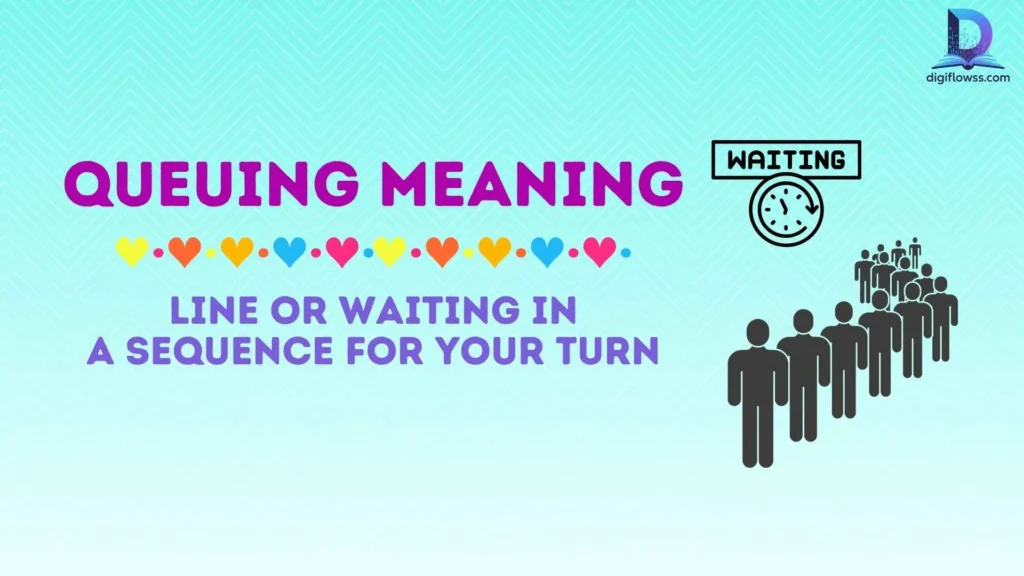
Queuing means standing in line or waiting in a sequence for your turn.
Word Origin
The word comes from the French word “queue,” meaning tail or line.
It entered the English language in the 18th century and became widely used in countries like the United Kingdom, where “queue” is the standard word for “line.”
Pronunciation
Queuing is pronounced:
/ˈkjuː-ɪŋ/
Sounds like: “Q-ing”
How the Meaning Evolved
Originally, queuing only referred to people standing in lines. Today, the concept also applies to:
- Computer processing systems
- Customer service systems
- Network traffic
- Task management software
So, queuing now describes any situation where items wait their turn in a sequence.
How to Use “Queuing” Correctly in Conversation
The word queuing is usually used in everyday English when talking about waiting in line.
Common Situations
You might hear it used when talking about:
- Airports
- Supermarkets
- Ticket counters
- Traffic lines
- Online systems
Example sentence:
“We spent 30 minutes queuing for concert tickets.”
Tone and Context
The word is neutral and descriptive, not slang.
It works in:
- Casual conversations
- News articles
- Academic writing
- Business discussions
When NOT to Use It
In American English, people often prefer the word “line” instead.
For example:
- British English: “People are queuing outside the store.”
- American English: “People are waiting in line outside the store.”
Both are correct depending on the region.
Real Conversation Examples Using “Queuing”
Here are some realistic examples of how people use the term in everyday conversations.
Example 1 — At a Coffee Shop
Friend 1: “Why is everyone outside?”
Friend 2: “They’re queuing for the new coffee launch.”
Meaning: People are waiting in a line for service.
Example 2 — Airport Situation
Traveler: “We spent an hour queuing for security.”
Friend: “Airports are always crowded during holidays.”
Meaning: Waiting in line before security screening.
Example 3 — Theme Park
Kid: “How long do we have to wait?”
Parent: “Probably 20 minutes. Everyone’s queuing for the roller coaster.”
Meaning: Guests waiting in a ride line.
Example 4 — Office Environment
Employee: “The printer isn’t working.”
IT Staff: “Your document is still queuing behind others.”
Meaning: The print job is waiting in a digital queue.
Example 5 — Online Gaming
Player: “Why can’t I join the server?”
Friend: “Too many players. You’re stuck queuing.”
Meaning: Waiting for a slot in the game server.
Common Mistakes & Misunderstandings
Even though the concept is simple, people often misunderstand how to use the word.
1. Confusing “Queue” and “Queuing”
- Queue: The line itself
- Queuing: The act of waiting in that line
Example:
Correct:
“People are queuing for tickets.”
Incorrect:
“People are queue for tickets.”
2. Thinking It Only Applies to People
Many assume queuing only applies to physical lines.
In reality, it also applies to:
- Computer tasks
- Printer jobs
- Network packets
- Customer service calls
3. Spelling Confusion
Because of the unusual spelling, people sometimes write:
- Queing ❌
- Queuing ✅
The correct spelling keeps the “ueue” sequence.
Queuing Across Different Industries & Systems
The idea of queuing appears in many areas beyond everyday life.
1. Customer Service
Businesses use queuing systems to manage customers.
Examples:
- Bank lines
- Call center waiting lists
- Ticket support systems
These systems help ensure fair and organized service.
2. Transportation
You see queuing in:
- Airport security lines
- Traffic congestion
- Bus stops
- Toll booths
Transportation planners study queuing to reduce delays.
3. Computer Science
In computing, queuing is extremely important.
Examples include:
- CPU task scheduling
- Printer job queues
- Network packet queues
- Message processing systems
These queues help systems process tasks in the correct order.
4. Entertainment & Events
Queuing is common in:
- Concert ticket lines
- Theme parks
- Gaming servers
- Online ticket releases
Some events even use virtual queues to avoid long physical lines.
Related Terms & Concepts
Here are related words often used with queuing.
| Term | Meaning |
|---|---|
| Queue | A line of people or tasks waiting |
| Waiting Line | American term for queue |
| FIFO | First In, First Out system |
| Queue Management | Organizing waiting lines |
| Virtual Queue | Online waiting system |
| Task Queue | List of tasks waiting to run |
| Buffer Queue | Temporary data storage line |
| Priority Queue | Tasks served by importance |
| Line Management | Customer flow control |
These terms appear frequently in business operations and computer science.
FAQs:
What is the meaning of queuing in simple words?
Queuing simply means waiting in line for your turn. It can involve people waiting for service or tasks waiting to be processed in a system.
Why do queues exist?
Queues exist because demand exceeds immediate service capacity. When many people or tasks need something at the same time, a queue forms so they can be served in order.
Is queuing the same as waiting?
Not exactly. Waiting is general, but queuing means waiting in an organized sequence or line.
What is a queuing system?
A queuing system is a structured process used to manage lines and waiting customers or tasks. Businesses and computer systems often use them to improve efficiency.
Where is queuing studied academically?
Queuing is studied in fields like:
- Operations management
- Computer science
- Industrial engineering
- Telecommunications
Researchers analyze queues to reduce waiting time and improve system performance.
Conclusion:
The queuing meaning is simple but surprisingly powerful. At its core, queuing describes the process of waiting in a line or sequence for your turn.
You see it everywhere from supermarket checkout lines to computer servers processing millions of tasks every second.
Understanding queuing helps explain how systems maintain order, fairness, and efficiency when many people or processes need the same resource.
Next time you’re waiting at a coffee shop or airport, you’ll recognize that you’re part of a classic queue system in action.
Curious about more modern language terms and concepts? Explore more guides and expand your knowledge of everyday communication.

Hi, I’m Candy Mark, the voice behind Digiflowss.com, where confusing words get clarity and trending slang finally makes sense.
I write for people who don’t have time for complicated definitions. If a word is blowing up online or showing up in conversations and you’re not 100% sure what it means, I break it down fast, simple, and in a way that actually sticks.