Ever read a sentence like Alcohol can impair your judgment and wondered exactly what impair meaning is?
You’re not alone. The word impair appears frequently in medical articles, news reports, school textbooks, and everyday conversations.
But many people still confuse it with similar words like damage, harm, or reduce.
Understanding the impair meaning is important because the word often describes how something affects your abilities like memory, vision, concentration, or decision-making.
What Does “Impair” Mean?
The impair meaning is simple once you break it down.
Definition:
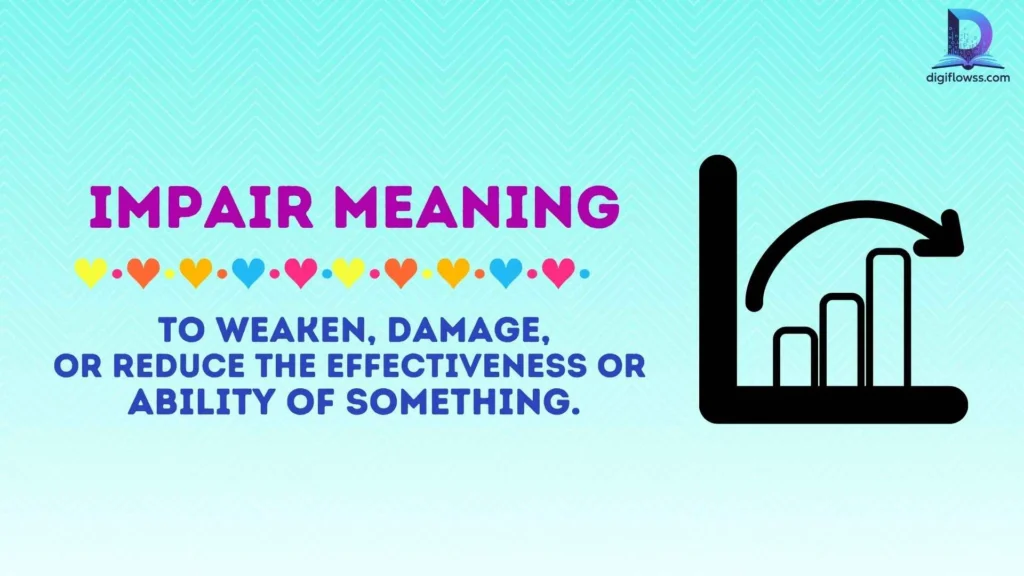
To impair means to weaken, damage, or reduce the effectiveness or ability of something.
It usually refers to functions or abilities becoming worse rather than completely destroyed.
Quick Answer:
Impair meaning: to weaken or reduce the effectiveness, quality, or ability of something.
Simple Examples
- Lack of sleep can impair memory.
- Bright sunlight may impair vision.
- Alcohol can impair judgment.
Origin of the Word
The word impair comes from the Old French word empeirier, meaning “to make worse.”
It ultimately traces back to the Latin word pejor, meaning “worse.”
Over time, the word evolved into modern English impair, which focuses on reducing ability or function.
Pronunciation Guide
Impair is pronounced as:
im-PAIR
Phonetic spelling:
/ɪmˈper/
The stress falls on the second part: PAIR.
How to Use “Impair” Correctly in Texts & Chat
Although impair is a common English word, it usually appears in serious or informational contexts rather than casual slang.
Typical Contexts
People often use impair when talking about:
- Health conditions
- Cognitive abilities
- Physical senses
- Mental performance
- Technology performance
Examples:
- Sleep deprivation can impair decision-making.
- Too much screen time may impair eyesight.
- Stress can impair productivity.
Platform-Specific Usage
SMS / WhatsApp
Usually used in informative messages.
Example:
“Driving while tired can impair your reaction time.”
Instagram / TikTok captions
Example:
“Late-night scrolling might impair your sleep cycle.”
Twitter / X discussions
Example:
“Alcohol consumption significantly impairs driving ability.”
Discord / Reddit
Often appears in debates or discussions.
Example:
“Lag can impair gameplay performance.”
When NOT to Use It
Avoid using impair in casual jokes or slang conversations because it sounds slightly formal.
Instead of:
“Pizza impaired my diet.”
People usually say:
“Pizza ruined my diet.”
Real Conversation Examples Using “Impair”
Below are realistic examples showing how the word is used in everyday communication.
Between Friends
Alex: I stayed up all night gaming.
Ryan: Dude, that’s going to impair your focus at school.
Meaning:
Ryan is saying sleep deprivation will reduce Alex’s concentration.
In a Family Conversation
Mom: Don’t sit too close to the TV.
Kid: Why?
Mom: It can impair your eyesight.
Meaning:
The mother is warning that it could weaken vision.
In a Workplace Chat
Manager: Fatigue can impair decision-making during long shifts.
Meaning:
Being tired may reduce the ability to make good decisions.
In a Medical Discussion
Doctor: This condition may impair mobility in older adults.
Meaning:
The illness could reduce a person’s ability to move.
Gaming Conversation
Player 1: My internet lagged so badly.
Player 2: Yeah, lag can impair gameplay performance.
Meaning:
Lag reduces the effectiveness of gameplay.
Common Mistakes & Misunderstandings
Even advanced English learners sometimes misuse the word impair.
Here are the most common mistakes.
1. Confusing Impair with Destroy
Incorrect:
“The storm impaired the house.”
Better:
“The storm damaged the house.”
Why?
Impair usually refers to function, not total destruction.
2. Using It for Small Problems
People sometimes exaggerate with the word.
Example:
“Coffee impaired my mood.”
This sounds unnatural. Instead say:
“Coffee ruined my mood.”
3. Generational Misunderstandings
Younger speakers may rarely use impair in casual speech.
Older generations, teachers, or professionals may use it more often in:
- Education
- Medicine
- Legal writing
4. Cultural Differences
In some English-learning countries, impair appears mostly in academic texts, which can make it feel overly formal in everyday speech.
“Impair” Across Different Platforms & Demographics
Language evolves across different communities.
Here’s how impair appears across demographics.
Gen Z
Gen Z rarely uses impair in casual slang.
Instead they say:
- mess up
- ruin
- weaken
- lower
Example:
“Lack of sleep messes up your focus.”
Millennials
Millennials may use the word in work, education, or health discussions.
Example:
“Stress can impair productivity.”
Academic and Medical Communities
The word impair is extremely common in:
- Psychology
- Medicine
- Scientific writing
- Legal contexts
Examples:
- cognitive impairment
- impaired judgment
- impaired vision
Organizations like Merriam-Webster and Oxford University Press also define impair similarly as reducing function or ability.
Related Slang, Abbreviations & Alternatives
Here are some related words and phrases you might see instead of impair.
| Word | Meaning |
|---|---|
| Damage | Physical harm to something |
| Harm | Cause injury or negative effects |
| Weaken | Make something less strong |
| Reduce | Make something smaller or less |
| Limit | Restrict ability |
| Deteriorate | Gradually become worse |
| Disrupt | Interrupt normal function |
| Undermine | Gradually weaken |
Synonyms in Casual Speech
Instead of saying:
“Sleep deprivation impairs focus.”
People may say:
“Sleep deprivation messes up your focus.”
Historical Evolution of the Word “Impair”
Language changes over time, but some words keep their core meaning for centuries. The word impair originated from Old French and entered Middle English around the 14th century. Early writers used it to describe anything that made a person, object, or situation worse.
As English evolved, the term became common in legal, medical, and academic writing. Today, it appears frequently in discussions about health conditions, workplace performance, education, and technology.
Understanding the historical background helps learners remember that impair has always carried a negative sense of reducing quality, strength, or effectiveness.
Why “Impair” Is Common in Medical Terminology
One reason many people encounter the word impair is its widespread use in healthcare.
Medical professionals often describe conditions that reduce normal bodily functions using terms such as:
- Visual impairment
- Hearing impairment
- Cognitive impairment
- Speech impairment
- Mobility impairment
In healthcare settings, impairment does not always mean complete loss of function. Instead, it often refers to a partial reduction in ability.
For example, a person with visual impairment may still see but not as clearly as someone with standard vision.
Impair vs Similar English Words
English contains several words that seem similar to impair, but their meanings differ slightly.
| Word | Meaning | Example |
|---|---|---|
| Impair | Reduce effectiveness | Stress can impair memory. |
| Affect | Influence something | Weather affected attendance. |
| Damage | Cause physical harm | The storm damaged the roof. |
| Hinder | Make progress difficult | Traffic hindered travel plans. |
| Undermine | Gradually weaken | Rumors undermined trust. |
Knowing these differences can improve both writing and speaking accuracy.
Common Situations Where You May Encounter the Word “Impair”
The word appears in many real-life situations.
Driving Safety
Authorities often warn that alcohol, drugs, and fatigue can impair driving ability.
Education
Teachers may discuss factors that impair learning, such as stress or lack of sleep.
Workplace Performance
Managers sometimes refer to issues that impair productivity, communication, or teamwork.
Technology
Software bugs and hardware failures can impair system performance.
Sports
Injuries can impair an athlete’s speed, balance, or endurance.
Because the word applies to so many situations, it remains an important part of modern English vocabulary.
Can Positive Things Ever Impair Something?
At first glance, this sounds impossible because impair has a negative meaning. However, even positive actions can unintentionally impair something else.
For example:
- Excessive exercise may impair recovery.
- Overconfidence can impair judgment.
- Too much multitasking may impair focus.
The action itself might not be negative, but its consequences can reduce effectiveness.
The Psychology Behind Impaired Decision-Making
Psychologists often study how certain factors affect judgment and decision-making.
Common causes of impaired thinking include:
- Sleep deprivation
- Emotional stress
- Alcohol consumption
- Anxiety
- Information overload
Research consistently shows that when the brain is overloaded or fatigued, decision quality often decreases.
This is why professionals in healthcare, aviation, and transportation emphasize adequate rest and mental clarity.
How “Impair” Appears in News Headlines
Journalists frequently use impair because it communicates a specific type of negative effect.
Examples include:
- “Drought Conditions Impair Crop Growth”
- “Network Outage Impairs Online Services”
- “Pollution May Impair Air Quality”
- “Economic Uncertainty Impairs Consumer Confidence”
In headlines, impair helps readers quickly understand that something’s effectiveness has been reduced.
Academic Usage of “Impair”
Students preparing for standardized tests often encounter the word impair in reading passages.
The term commonly appears in subjects such as:
Biology
Scientists may discuss substances that impair cellular functions.
Psychology
Researchers examine factors that impair memory and cognition.
Environmental Science
Pollution can impair ecosystems and wildlife habitats.
Economics
Market disruptions may impair business operations and economic growth.
Learning the word can improve reading comprehension scores and academic vocabulary.
Most Common Word Combinations With “Impair”
Native English speakers frequently pair impair with specific nouns.
Impair Judgment
Alcohol can impair judgment during important decisions.
Impair Vision
Certain eye conditions may impair vision.
Impair Memory
Chronic stress can impair memory retention.
Impair Performance
Technical issues may impair employee performance.
Impair Function
Disease can impair organ function.
Learning these collocations helps you sound more natural when writing and speaking English.
How to Remember the Meaning of Impair
A simple memory trick can make the word easier to remember.
Think of:
Impair = Make Poorer
Both words begin with a similar sound and share the idea of reducing quality or effectiveness.
Another easy association:
Impair = Not Performing at Full Power
Whenever something is functioning below its normal level, impair is often the correct word.
Impair in Literature and Formal Writing
Authors, researchers, and journalists often prefer impair because it sounds precise and professional.
Instead of saying:
“The problem made the system worse.”
A formal writer may say:
“The problem impaired system performance.”
This concise wording explains the issue more clearly and professionally.
Key Takeaways About Impair Meaning
- Impair means to weaken, damage, or reduce effectiveness.
- The word is commonly used in healthcare, education, business, and technology.
- It always carries a negative meaning.
- It is more formal than words like hurt or weaken.
- Common phrases include impaired judgment, impaired vision, and impaired performance.
- Understanding impair can improve vocabulary, reading comprehension, and professional communication.
How Impair Is Used in Legal Language
The word impair appears frequently in legal documents because laws often address situations where a person’s rights, abilities, or judgment may be reduced.
For example, courts may discuss whether a person’s mental state was impaired at the time of making a decision. Insurance policies may also mention conditions that impair an individual’s ability to work.
Legal professionals prefer the word because it clearly communicates that something has been weakened or diminished without necessarily being completely lost.
Common legal phrases include:
- Impaired judgment
- Impaired capacity
- Impair contractual rights
- Impair earning ability
Because of its precision, the term remains common in contracts, regulations, and court rulings.
The Difference Between Impairment and Disability
Many people mistakenly use impairment and disability interchangeably, but they are not always the same.
An impairment refers to a reduction in physical, mental, sensory, or cognitive function.
A disability, on the other hand, refers to limitations that may result from an impairment and affect daily activities.
For example:
- A hearing impairment affects hearing ability.
- The resulting disability may involve challenges in communication or accessing certain environments.
Understanding this distinction is important in healthcare, education, and accessibility discussions.
How Employers Use the Term Impair in the Workplace
Organizations often use the word impair when discussing factors that reduce employee performance or workplace safety.
Examples include:
- Fatigue impairing concentration
- Stress impairing productivity
- Poor communication impairing teamwork
- Equipment failures impairing operations
Many workplace safety policies specifically address conditions that may impair an employee’s ability to perform duties safely.
This is especially important in industries such as transportation, healthcare, manufacturing, and construction.
How Environmental Factors Can Impair Daily Life
Environmental conditions can affect human health, productivity, and quality of life.
Examples include:
Air Pollution
Poor air quality may impair breathing and lung function.
Noise Pollution
Excessive noise can impair concentration and sleep quality.
Extreme Weather
Heatwaves may impair physical performance and endurance.
Poor Lighting
Inadequate lighting can impair visibility and workplace safety.
These examples demonstrate how the word extends beyond personal health and applies to broader environmental conditions.
Impair Meaning in Psychology and Mental Health
Psychologists frequently use the term when discussing cognitive and emotional functioning.
Mental health conditions may impair:
- Attention
- Memory
- Problem-solving
- Emotional regulation
- Social interaction
For example, severe anxiety can impair a person’s ability to focus on tasks, while chronic depression may impair motivation and decision-making.
In psychology, the term does not imply permanent damage. Many impairments can improve with treatment, support, and lifestyle changes.
How Sleep Deprivation Can Impair the Brain
Sleep is essential for healthy cognitive functioning.
Research shows that insufficient sleep can impair:
Memory Formation
The brain struggles to store new information effectively.
Attention Span
People become more easily distracted.
Decision-Making
Judgment often becomes slower and less accurate.
Reaction Time
Responses to situations may become delayed.
This is why students, professionals, and drivers are encouraged to prioritize adequate rest.
Impair Meaning in Sports and Physical Performance
Athletes and coaches often use the concept of impairment when discussing performance factors.
Several conditions can impair athletic ability:
- Dehydration
- Injury
- Illness
- Fatigue
- Poor nutrition
Even small impairments can significantly impact performance at competitive levels.
For example, mild dehydration may impair endurance and reduce overall physical output during intense activity.
How Technology Problems Can Impair Business Operations
Modern businesses rely heavily on digital systems.
When technology fails, it can impair critical functions such as:
- Customer service
- Communication
- Data processing
- Online sales
- Remote collaboration
A slow website, software bug, or cybersecurity issue may impair efficiency and affect customer satisfaction.
Because technology is central to most industries, organizations invest heavily in preventing operational impairments.
Why Educators Use the Word Impair Frequently
Teachers and educational researchers often discuss factors that affect learning outcomes.
Several challenges may impair academic performance:
- Lack of sleep
- Test anxiety
- Learning disorders
- Classroom distractions
- Poor study habits
The word helps educators explain why students may struggle even when they have the necessary knowledge and abilities.
Understanding these barriers allows schools to create more effective learning environments.
Impair Meaning in Financial and Accounting Terms
In accounting, the word impair has a specialized meaning.
An asset is considered impaired when its market value falls below its recorded value on a company’s financial statements.
Examples of impaired assets include:
- Buildings
- Equipment
- Patents
- Investments
- Business goodwill
When impairment occurs, companies may need to record a financial loss.
This accounting usage differs slightly from everyday English but still reflects the core idea of reduced value or effectiveness.
Common Idioms and Expressions Related to Impairment
Although impair itself is not commonly used in idioms, several English expressions convey a similar idea.
Examples include:
- Running on empty
- Not at full capacity
- Under the weather
- Below par
- Off your game
These phrases are often used in casual conversation to describe reduced performance or ability.
Understanding them can help learners recognize related concepts in everyday English.
How Media and Entertainment Use the Concept of Impairment
Movies, television shows, and novels frequently explore themes involving impairment.
Characters may experience:
- Memory impairment
- Vision impairment
- Emotional impairment
- Physical impairment
These storylines often highlight resilience, adaptation, and personal growth.
As a result, audiences encounter the concept regularly, even if the exact word impair is not always used.
Why Understanding Impair Improves English Vocabulary
Learning advanced vocabulary is not just about memorizing definitions.
Words like impair help you:
Write More Professionally
Formal vocabulary strengthens essays, reports, and business communication.
Understand Academic Texts
The term appears frequently in textbooks and research papers.
Improve Reading Comprehension
Knowing the word helps readers interpret complex information more accurately.
Expand Expressive Ability
Instead of repeatedly using words like “hurt” or “damage,” you can choose more precise language.
Strong vocabulary improves both confidence and communication skills.
Future Trends: How the Word Impair Is Evolving
As technology and healthcare continue to advance, new uses of the word impair are emerging.
Modern discussions often involve:
- Digital impairment
- Cognitive overload
- Technology-induced attention impairment
- Social media’s impact on focus
- AI-related performance concerns
While the core meaning remains unchanged, the contexts in which people use the word continue to expand.
This ongoing evolution ensures that impair remains a relevant and widely used term in modern English.
Expert Tips for Using Impair Naturally in Writing
If you want your English to sound more polished, follow these guidelines:
Use It for Formal Situations
The word works best in academic and professional writing.
Pair It With Abilities or Functions
Examples include:
- Impair judgment
- Impair memory
- Impair performance
- Impair vision
How Children Learn the Meaning of Impair
Children usually encounter the word impair in school textbooks, science lessons, or health education materials. Since the term is more formal than everyday words like “hurt” or “damage,” teachers often introduce it through real-world examples.
For instance, students may learn that excessive noise can impair hearing or that poor nutrition can impair growth. These practical examples help young learners understand that impairment refers to a reduction in normal function rather than a complete loss.
Teaching the word through relatable situations makes it easier to remember and apply correctly in writing assignments and classroom discussions.
Why Scientists Prefer the Word Impair
Scientific writing values precision. Researchers often choose the word impair because it clearly describes a measurable reduction in performance, function, or ability.
For example, a study might examine whether a chemical impairs memory, whether pollution impairs plant growth, or whether a disease impairs immune function.
Unlike broader terms such as “affect,” impair specifically indicates that the impact is negative. This makes research findings more accurate and easier to interpret.
The Role of Impairment in Public Safety Campaigns
Governments and public health organizations frequently use the term impair in awareness campaigns.
These campaigns often focus on risks that may impair a person’s ability to make safe decisions or perform tasks responsibly.
Examples include:
- Driving while fatigued
- Using a phone while driving
- Consuming alcohol before operating machinery
- Working under extreme stress
Public safety messages rely on the term because it communicates a clear reduction in judgment, awareness, or physical ability.
How Impair Is Used in Accessibility Discussions
Accessibility professionals often discuss impairments when designing environments, products, and services that accommodate diverse needs.
Examples include:
Visual Impairments
Challenges related to seeing text, objects, or surroundings clearly.
Hearing Impairments
Difficulties with hearing sounds, speech, or alerts.
Mobility Impairments
Limitations affecting movement, balance, or coordination.
Cognitive Impairments
Conditions that affect memory, attention, learning, or problem-solving.
Understanding these categories helps organizations create more inclusive experiences for everyone.
How Aging Can Affect and Impair Certain Abilities
As people grow older, some physical and cognitive abilities may naturally decline.
Aging can sometimes impair:
- Balance
- Reaction speed
- Hearing
- Vision
- Short-term memory
However, impairment is not an inevitable outcome for every individual. Healthy habits, medical care, and mental stimulation can help maintain many abilities throughout life.
This distinction is important because aging and impairment are related but not identical concepts.
Common Headlines That Use the Word Impair
Readers often encounter the word in newspapers, magazines, and online publications.
Typical examples include:
- “Economic Slowdown Could Impair Business Growth”
- “Poor Air Quality May Impair Respiratory Health”
- “Cyberattack Impairs Critical Services”
- “Flooding Impairs Transportation Networks”
These headlines demonstrate how the word applies to people, organizations, systems, and entire communities.
How Impair Differs From Destroy
Although both words describe negative outcomes, their severity is very different.
Impair
Something continues to function, but not as effectively.
Example:
“The injury impaired his ability to run.”
Destroy
Something is completely ruined or no longer functional.
Example:
“The fire destroyed the building.”
This distinction helps writers choose the most accurate word for a situation.
Can Temporary Problems Cause Impairment?
Yes. An impairment does not have to be permanent.
Many temporary situations can impair normal functioning, including:
- Illness
- Exhaustion
- Stress
- Medication side effects
- Dehydration
For example, a person with a fever may experience impaired concentration for a few days but recover fully afterward.
Recognizing the temporary nature of some impairments helps avoid unnecessary confusion.
How Businesses Measure Performance Impairment
Companies often monitor factors that reduce efficiency or productivity.
Common indicators include:
Reduced Output
Employees produce less work than expected.
Increased Errors
Mistakes become more frequent.
Slower Processes
Tasks take longer to complete.
Lower Customer Satisfaction
Service quality declines.
When these issues appear, organizations investigate whether operational problems are impairing performance.
The Importance of Context When Interpreting Impair
The exact meaning of impair can vary depending on the subject being discussed.
For example:
- Impaired vision relates to eyesight.
- Impaired judgment relates to decision-making.
- Impaired mobility relates to movement.
- Impaired communication relates to information exchange.
Although the core idea remains the same—reduced effectiveness—the specific impact depends on context.
Readers should always consider what ability or function is being impaired.
How Impair Is Tested in English Exams
Vocabulary tests and language proficiency exams frequently include the word impair because it measures advanced reading comprehension.
Students may be asked to:
- Choose the correct synonym
- Identify the word in context
- Complete sentence-based questions
- Distinguish impair from similar words
Understanding its precise meaning can improve performance on academic assessments and standardized language tests.
Industries Where the Word Impair Appears Most Often
Some sectors use the term far more frequently than others.
Healthcare
Discussing physical, sensory, and cognitive impairments.
Education
Analyzing factors that impair learning outcomes.
Transportation
Addressing impaired driving and safety concerns.
Technology
Describing reduced system functionality.
Finance
Referring to asset impairment and valuation changes.
Law
Evaluating impaired judgment, rights, or capacities.
Knowing these industries can help readers understand why they encounter the word in professional documents.
Why Clear Communication About Impairment Matters
Misunderstanding the term can lead to confusion, especially in healthcare, education, and workplace settings.
When professionals accurately describe an impairment, they help others understand:
- The nature of the challenge
- Its severity
- Its impact on daily activities
- Potential support or solutions
Clear communication promotes better decision-making and reduces misunderstandings.
Modern Technology Designed to Reduce Impairments
Innovative technologies help people overcome or manage many forms of impairment.
Examples include:
- Screen readers for visual impairments
- Hearing aids for hearing impairments
- Speech-to-text software
- Mobility assistance devices
- Cognitive support applications
These advancements improve independence and accessibility for millions of people worldwide.
What Vocabulary Experts Want You to Remember About Impair
Language experts emphasize three key points:
- Impair always suggests a negative reduction in function.
- The function usually remains partially intact rather than completely lost.
- The word is most common in formal, academic, medical, and professional contexts.
Remembering these principles will help you use the word accurately and confidently in both speech and writing.
Lesser-Known Uses of Impair in Specialized Fields
Beyond everyday English, the term appears in several niche areas.
Insurance
Policies may evaluate whether an injury impairs earning capacity.
Aviation
Pilots are trained to avoid factors that impair judgment or reaction time.
Military Operations
Commanders assess conditions that may impair mission effectiveness.
Engineering
Experts study failures that impair system reliability.
These specialized uses demonstrate the versatility and importance of the word across many professions.
FAQs:
What does impair mean in simple terms?
The impair meaning is to weaken, damage, or reduce the effectiveness of something. It is often used when talking about abilities like vision, memory, judgment, or performance becoming worse.
What is an example sentence for impair?
A common example is:
“Alcohol can impair your ability to drive safely.”
This means alcohol reduces your reaction time and decision-making ability.
What does impaired mean?
Impaired describes a condition where an ability is weakened.
Examples include:
- impaired vision
- impaired hearing
- impaired judgment
It means the ability still exists but does not function normally.
Is impair a formal word?
Yes, impair is generally considered a formal English word. It is commonly used in academic writing, medical discussions, legal contexts, and news articles.
What is the difference between impair and damage?
The key difference is:
- Damage often refers to physical harm.
- Impair refers to reduced function or effectiveness.
Example:
- A crash can damage a car.
- Alcohol can impair driving ability.
Conclusion:
Understanding the impair meaning helps you better interpret news, academic writing, and everyday conversations about health, ability, and performance.
Simply put, impair means to weaken or reduce the effectiveness of something whether it’s memory, vision, judgment, or productivity.
You’ll often see the word used in medical contexts like impaired vision or impaired cognitive function, but it can also appear in everyday discussions about sleep, stress, and performance.
Now that you know how to use it correctly, try spotting impair in articles, news reports, or conversations. You’ll notice it everywhere once you know what it means.
Got a favorite English word you want explained next? Drop it in the comments and explore more language guides!

Hi, I’m Alex Mark, the writer and Creator behind digiflowss.com, where meanings aren’t just explained… they’re made easy to understand and actually useful.
I started this platform with one simple goal: to break down words, slang, and expressions in a way that feels clear, fast, and real. No complicated definitions. No textbook vibes. Just straight answers that help you understand what people really mean—online and in real life.