Ever heard someone mention a barrow and wondered what they meant? Maybe you saw the word in a gardening guide, a history documentary, or even a crossword puzzle. The truth is, the barrow meaning can change depending on the context and that’s exactly why people search for it.
In everyday language, a barrow usually refers to a small cart used for carrying materials. Think of the classic garden wheelbarrow filled with soil or bricks. But in historical or archaeological contexts, a barrow can mean something completely different: an ancient burial mound used thousands of years ago.
Understanding the meaning of this word matters more than you might think. Whether you’re reading historical texts, gardening guides, or academic material, knowing how the word is used helps avoid confusion.
In this guide, you’ll learn:
- The true definition of barrow
- Where the word originated
- How it’s used in modern conversations
- Real examples in everyday language
- Common misunderstandings people make
This guide is updated for 2026 and designed to give you the clearest explanation of the word online.
What Does Barrow Meaning Actually Refer To?
Simple Definition
The barrow meaning generally refers to one of two things:
- A small cart used for carrying loads, especially a wheelbarrow used in gardening or construction.
- An ancient burial mound built over graves in prehistoric times.
Quick Answer
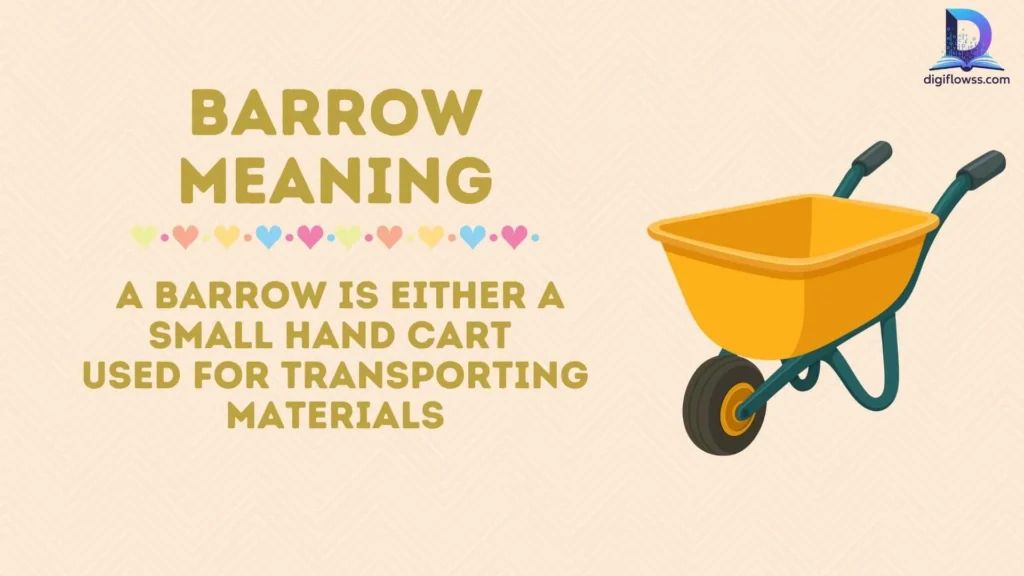
Barrow meaning: A barrow is either a small hand cart used for transporting materials (like a wheelbarrow) or an ancient mound of earth used as a burial site in historical contexts.
Origin of the Word
The word barrow comes from Old English and has Germanic linguistic roots. Historically, the word developed in two separate ways:
- From Old English “bearwe”, referring to a mound or hill (used in burial sites).
- From Old English “bearwe” related to carrying, which evolved into the modern wheelbarrow.
Over centuries, these meanings merged into one word with different contextual uses.
Pronunciation Guide
Barrow is pronounced:
BAIR-oh
It rhymes with words like:
- narrow
- arrow
- sparrow
How to Use Barrow Correctly in Texts and Conversation
Understanding how to use barrow correctly depends on context.
Everyday Usage
Most people use barrow when referring to:
- gardening tools
- construction equipment
- farming equipment
Example sentence:
“Grab the barrow so we can move this soil to the garden bed.”
Professional or Academic Usage
In archaeology or history discussions, barrow refers to burial sites.
Example:
“The archaeologists discovered a Bronze Age barrow near the village.”
Where You Might See the Word
Common places where the word appears include:
- gardening blogs
- DIY construction guides
- historical documentaries
- archaeology books
- museum descriptions
When NOT to Use It
Avoid using barrow in professional communication unless the topic involves:
- landscaping
- construction tools
- historical burial sites
For example, you wouldn’t normally say:
“I’ll barrow these files to the meeting.”
That would be incorrect because barrow is not a verb in modern English.
Real Conversation Examples Using Barrow
Between Neighbors (Gardening Context)
Alex: “Can I borrow your barrow for a minute?”
Sam: “Sure, it’s behind the shed.”
Meaning: Alex needs a wheelbarrow to move something heavy.
At a Construction Site
Worker 1: “Load the gravel into the barrow.”
Worker 2: “Got it.”
Meaning: A wheelbarrow used to move construction material.
In a History Class
Teacher: “Ancient leagues buried their leaders in barrows.”
Meaning: The word refers to burial mounds.
During an Archaeology Documentary
Narrator:
“Researchers uncovered a Viking barrow believed to be over 1,000 years old.”
Meaning: A historical grave mound.
In a Garden Center
Customer:
“Do you sell metal barrows or just plastic ones?”
Meaning: Different types of wheelbarrows.
Common Mistakes and Misunderstandings
1. Confusing Barrow With Borrow
One of the most common mistakes is mixing up barrow and borrow.
Example:
Incorrect:
“I need to barrow your shovel.”
Correct:
“I need to borrow your shovel.”
The two words sound similar but mean completely different things.
2. Assuming It Only Means Wheelbarrow
While many people use barrow to mean wheelbarrow, historians and archaeologists use it differently.
Examples of burial barrows include:
- Bronze Age barrows
- Viking barrows
- Neolithic burial mounds
3. Thinking It’s Modern Slang
Unlike internet slang or texting abbreviations, barrow is actually a very old English word.
It dates back over 1,000 years.
Barrow Across Different Contexts and Demographics
Gardening and DIY Communities
Homeowners and gardeners use the word when discussing tools.
Example:
“Fill the barrow with compost.”
Construction Workers
Builders and contractors frequently refer to wheelbarrows simply as barrows.
Example:
“Bring two barrows of cement.”
Historians and Archaeologists
In academic fields, the word is commonly used when discussing ancient burial structures.
Examples include:
- Long barrows
- Round barrows
- Chambered barrows
These structures are found across Europe and date back thousands of years.
General Public Usage
For most people today, barrow meaning is strongly associated with wheelbarrows used in gardening or construction.
Related Words and Similar Terms
Here are words closely related to barrow meaning:
| Word | Meaning |
|---|---|
| Wheelbarrow | A one-wheeled cart for carrying loads |
| Cart | A vehicle used for transporting goods |
| Trolley | Small wheeled platform used for carrying items |
| Handcart | A small manual transport cart |
| Burial mound | A raised earth mound covering a grave |
| Tumulus | Archaeological term for burial mound |
| Cairn | A mound of stones used as a marker or burial site |
| Barrow mound | Another term for burial barrow |
| Garden cart | A larger alternative to a wheelbarrow |
These words often appear in similar contexts depending on whether the discussion is about tools or archaeology.
FAQs:
What is the simple meaning of barrow?
A barrow is usually a small cart used to carry loads, commonly known as a wheelbarrow. In historical contexts, it can also refer to an ancient burial mound built over graves.
Why is it called a wheelbarrow?
The name combines wheel and barrow, referring to a single-wheel cart used for transporting materials by hand.
What is a barrow in archaeology?
In archaeology, a barrow is a mound of earth or stones placed over a grave. These structures were common in prehistoric Europe and were used to bury important individuals.
Are burial barrows still found today?
Yes. Archaeologists continue discovering ancient barrows across Europe, especially in the UK, Scandinavia, and parts of Central Europe.
Is barrow a commonly used word today?
Yes, but mainly in specific contexts such as gardening, construction, and historical discussions.
Conclusion:
The barrow meaning may seem simple at first, but the word actually carries centuries of history behind it.
In modern life, most people use barrow as a short way of saying wheelbarrow — the familiar cart used in gardening, farming, and construction.
But historically, the word also refers to ancient burial mounds, giving it an important place in archaeology and history.
Understanding both meanings helps you recognize the word in different contexts, whether you’re reading about ancient civilizations or working in your backyard garden.
Language is full of words like this simple on the surface but rich in meaning once you explore them.

Hi, I’m Candy Mark, the voice behind Digiflowss.com, where confusing words get clarity and trending slang finally makes sense.
I write for people who don’t have time for complicated definitions. If a word is blowing up online or showing up in conversations and you’re not 100% sure what it means, I break it down fast, simple, and in a way that actually sticks.